
 by
by temp-2
- July 13, 2026
- Blog
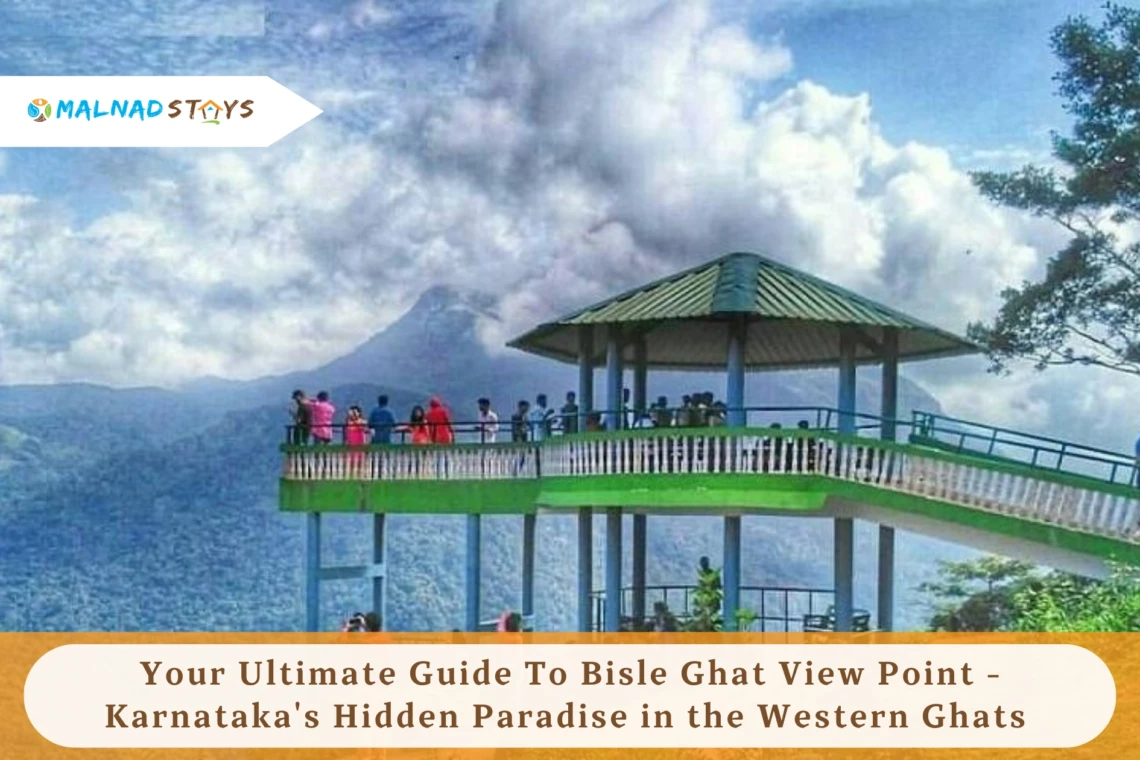
Standing at Bisle Ghat View Point, the silence reaches you first. The scale arrives a moment later. Three separate mountain ranges line the horizon from a single vantage: Kumara Parvatha to the left, Pushpagiri at the centre, Dodda Betta anchoring the southern edge. Far below, the Giri River threads through the valley as a narrow silver line through the forest canopy. People drive close to 250 kilometres from Bangalore for this view. They keep coming back for the same reason.
This guide covers everything you need to plan your trip to Bisle Ghat View Point in Karnataka: what to see when you arrive, the right season to visit, how to get there, and where to stay to catch the sunrise that day-trippers always miss.
Bisle Ghat View Point is located about 3,800 feet above sea level, around 5 km from Bisle village, on the border of Hassan and Dakshina Kannada districts. While the elevation is impressive, the real highlight is the panoramic view of three iconic mountain ranges from a single location.
Standing at the viewpoint, you can see:
Seeing all three mountain ranges together from one viewpoint is rare, making Bisle Ghat View Point one of the most unique scenic spots in Karnataka.
Flowing through the valley below, the Giri River separates these mountain ranges. From the viewpoint, it looks like a thin silver ribbon winding through the dense forests. This natural divide creates beautiful layers across the landscape, making the valley appear even more dramatic and expansive.
The Forest Department shelter at the main viewpoint is the only one of the four viewpoints along this road that offers seating, making it an ideal place to relax and enjoy the scenery.
If you continue about 400 metres further, you’ll reach another viewpoint with a slightly different perspective of the valley. Many photographers prefer this location for its wider composition and uninterrupted views. Since it’s only a short walk away, it’s well worth visiting before you leave.
The viewpoint is only part of what makes Bisle Ghat worth the drive. The Bisle Reserve Forest that surrounds it is one of the Western Ghats’ most significant protected areas, covering approximately 3,135 hectares of lowland evergreen forest.
This isn’t a safari park or a managed wildlife circuit. It’s a protected corridor linking the Pushpagiri Wildlife Sanctuary to the broader Western Ghats ecosystem, and wildlife moves through it freely.
Commonly encountered near the viewpoint area:
Rarely spotted, but present in the reserve:
Western Ghats endemic species found here:
Both the Nilgiri marten and the Malabar Giant Squirrel signal genuine old-growth habitat. Birders find the 6 to 8 AM window most productive, when Western Ghats endemic species are most vocal and active in the canopy.
The forest’s high-value timber species include teak, rosewood, Indian copal, Alexandria laurel, and Malabar kino. All are old-growth trees layered across multiple canopy storeys rather than plantation species, and the difference shows in how the forest feels: cool, dense, and unmistakably old.
In the monsoon months of July to September, the undergrowth intensifies with the rains. The green deepens to a near-black density. Even on days when cloud covers the viewpoint entirely, the forest below is at its most visually dramatic.
Each season at Bisle Ghat offers a genuinely different experience. Here’s what to expect across the year:
| Season | Months | Conditions | Good For | Watch Out For |
| Post-Monsoon | Oct – Feb | 15–20°C, clear | First-timers, families, wildlife | Dec–Jan crowds; arrive early weekdays |
| Monsoon | Jun – Sep | Warm, heavy rain | Photographers, mist lovers | Fog, leeches, slippery roads |
| Summer | Mar – May | Up to 35°C afternoons | Quiet, uncrowded | Hot midday; visit before 8 AM |
October to February is the recommended window for most visitors. The monsoon is over, the forest stays lush from the rains, and the sky clears for unobstructed views of all three mountain ranges.
Wildlife is more active in this window. Animals move more freely through the forest once the heavy rains ease, making it the most reliable period for birdwatchers.
December and January attract the most visitors. Arrive on a weekday and reach the viewpoint by 10 AM to avoid the midday crowd.
The monsoon transforms Bisle Ghat. The Giri River swells, the forest reaches its deepest green, and cloud formations roll through the valley visibly throughout the day. For photographers, this is often the preferred season over any other.
Fog is the real trade-off to prepare for. On a heavily overcast morning, you can drive 35 kilometres and find nothing but white at the viewpoint. Check conditions with your homestay before making the drive, and choose a partially cloudy day over a completely overcast one.
Two things to prepare for specifically in monsoon:
This window suits photographers and travellers who accept variable outcomes. Families with young children generally find October to February more manageable.
Summer afternoons reach 30 to 35 degrees Celsius, but the season is considerably less crowded than the December to January peak.
Arriving before 8 AM gives you cool air, clear visibility, and low crowds. The forest looks drier than in monsoon but the Western Ghats canopy stays substantially green year-round. Leeches are minimal, the road is dry, and the experience is predictable.
Bisle Ghat is accessible by road from three main directions. Private transport is the practical choice; public bus connections are sparse and unreliable for planned trips.
The route runs approximately 230 to 260 kilometres via State Highway 48 toward Hassan and Sakleshpur, then onwards to Bisle Ghat View Point. Drive time is 4.5 to 5.5 hours; leaving before 7 AM clears the outer ring road before the morning rush builds.
Two things to sort before you leave Sakleshpur:
Sakleshpur to Bisle Ghat View Point is approximately 35 to 40 kilometres, taking 1 to 1.5 hours on the winding forest road. The first half of the drive passes through coffee estates, and the shade and fragrance on this stretch are genuinely part of the experience.
From Kukke Subramanya
Kukke Subramanya to Bisle Ghat View Point is approximately 20 to 22 kilometres via the ghat road. This route is popular with travellers combining a morning temple visit with an afternoon at the viewpoint. Take the hairpin bends at a relaxed pace, especially in monsoon.
Quick reference before you set off:
| Detail | Info |
| Timings | Generally 9 AM to 6 PM daily |
| Entry fee | Nominal forest fee at checkpoint; carry cash and confirm on arrival |
| Parking | Roadside only; no dedicated area |
| Mobile network | No coverage on ghat road or at viewpoint |
| Nearest town | Sakleshpur, approximately 35–40 km away |
Arriving by 10 AM gives you the clearest light and coolest air of the day. The main viewpoint path is accessible for older adults and children; reserve forest trekking is a separate activity.
What to carry:
The main trail at Bisle Ghat runs from the road to the viewpoint shelter: approximately 0.3 kilometres of easy, level walking that most visitors complete in 15 to 20 minutes, suitable for all fitness levels.
From the main viewpoint, an unmarked path continues approximately 400 metres to the second viewpoint, offering a different angle of the valley. The gradient is gentle, and photographers often head here straight after the first spot.
Trekking inside Bisle Reserve Forest is a separate and more serious undertaking:
Malnad Stays partner homestays near Bisle can connect you with local guides on request, people who know the forest’s seasonal conditions, safe movement zones, and the trails that don’t appear on any mapping app.
If trekking is your main reason for visiting Karnataka, explore our Trekking Stays in Karnataka for properties placed near forest trails across the Western Ghats.
Bisle Ghat View Point faces west-southwest, which shapes the photography calendar here more than anything else.
The best times and conditions:
Composition and equipment:
Bisle Ghat pairs naturally with several nearby attractions. Here’s what’s within reach on a two-day trip:
| Place | Distance | Best Time | Notes |
| Kukke Subramanya Temple | 21 km | Any season | Temple morning + Bisle afternoon is a natural circuit |
| Manjarabad Fort | 47.7 km | Any season | Star-shaped fort by Tipu Sultan; add on Day 2 return drive |
| Mallalli Falls | ~50 km | July – November | Seasonal; best when rivers are full |
| Mookanamane Falls | ~60 km | July – November | Worth it on a 3-night Sakleshpur stay |
| Patla Betta | ~40 km | October – February | Half-day trek; book a local guide before you go |
Kukke Subramanya Temple is the closest and most popular pairing. The Kumaradhara River flows alongside the complex, and many devotees take a ritual dip before entering. The drive from Bisle Ghat takes under an hour on the same ghat road.
Manjarabad Fort is one of only three star-shaped forts in India, built in the late 18th century under Tipu Sultan’s orders. It works well as an afternoon stop on the return drive toward Sakleshpur on Day 2.
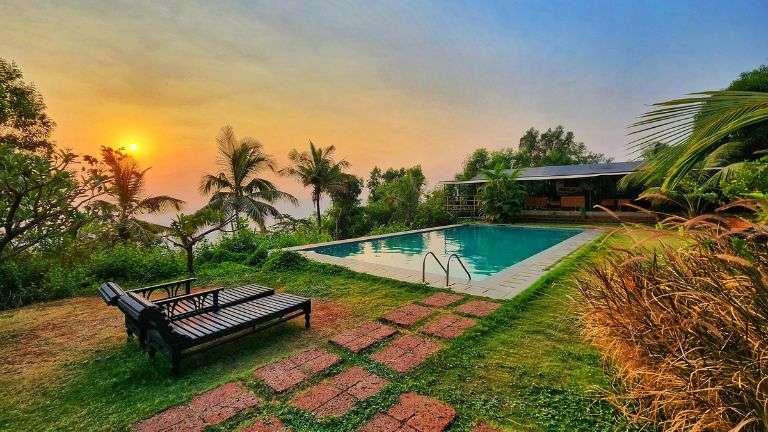
Staying near Bisle Ghat rather than day-tripping from Bangalore changes the experience significantly.
Sunrise at the viewpoint happens between 6 and 7 AM. That window isn’t reachable if you’re still on the highway from the city. One night near Bisle means arriving at first light, when the valley mist is at its most striking.
Malnad Stays curates homestays and small resorts near Bisle Ghat. Every property on our platform has been personally visited by the team, held to the same standard we’d apply for our own families.
What to expect at a Malnad Stays property in this region:
We hold a 4.8 Google rating, earned across over a lakh guests since 2018.
Explore stays near Bisle Ghat or browse our Jungle Stays in Karnataka for forest-immersed properties across the Western Ghats.
This two-day plan covers both sunset and sunrise at the viewpoint, without requiring early-morning city driving on either day.
Day 1
Day 2
This plan fits a Friday night departure or an early Saturday morning start. Staying locally is what makes it work. Both golden windows at the viewpoint are reachable without rushing.
Plan your next escape with Malnad Stays! Book your stay near Bisle Ghat View Point and let our team handle the rest: property recommendations, local guide connections, and a personalised itinerary built around what you want from the trip. Enquire Now or reach us on WhatsApp.
A nominal forest entry fee may be collected at the checkpoint on the approach to the viewpoint. Carry small cash and confirm the amount at the gate on arrival, as the fee is subject to change.
Bisle Ghat View Point is generally accessible from 9 AM to 6 PM daily. For sunrise, plan to arrive by 6 AM, which is practical if you’re staying locally in Sakleshpur or near Bisle.
Bisle Ghat View Point is approximately 230 to 260 kilometres from Bangalore via State Highway 48 through Hassan and Sakleshpur. Drive time is 4.5 to 5.5 hours depending on city traffic.
Yes. The main viewpoint path is approximately 0.3 kilometres on level ground and accessible for children of most ages. Forest trekking inside the reserve requires adult supervision and a local guide. October to February is the most comfortable season for a family’s first visit.
Trekking into the reserve interior without a guide is not advisable. Trails are unmarked, the forest is dense, and wildlife including elephants and king cobras is active. The short viewpoint trail is marked and safe to walk independently. Malnad Stays partner homestays near Bisle can arrange experienced local guides on request.
Sambar deer, spotted deer, peacocks, langurs, king cobras, and Mahasheer fish are the species most likely to be encountered. Tigers, leopards, and elephants are present in the reserve but are rarely spotted. The Nilgiri marten and Malabar Giant Squirrel, both Western Ghats endemics, are also found here. Birdwatchers find the 6 to 8 AM window most productive.
Bisle Ghat in monsoon is a worthwhile visit if you go in with realistic expectations. The forest reaches its deepest green, and cloud formations through the valley offer dramatic photography conditions. Heavy cloud can reduce viewpoint visibility to zero on some mornings, so check conditions with your homestay before driving up. The ghat road requires more care in wet weather, and leeches are present in the forest.








Join The Discussion